> For the complete documentation index, see [llms.txt](https://docs.dispel.com/llms.txt). Markdown versions of documentation pages are available by appending `.md` to page URLs; this page is available as [Markdown](https://docs.dispel.com/changelog/earlier-releases/2024-01-29.md).
# 29 January 2024
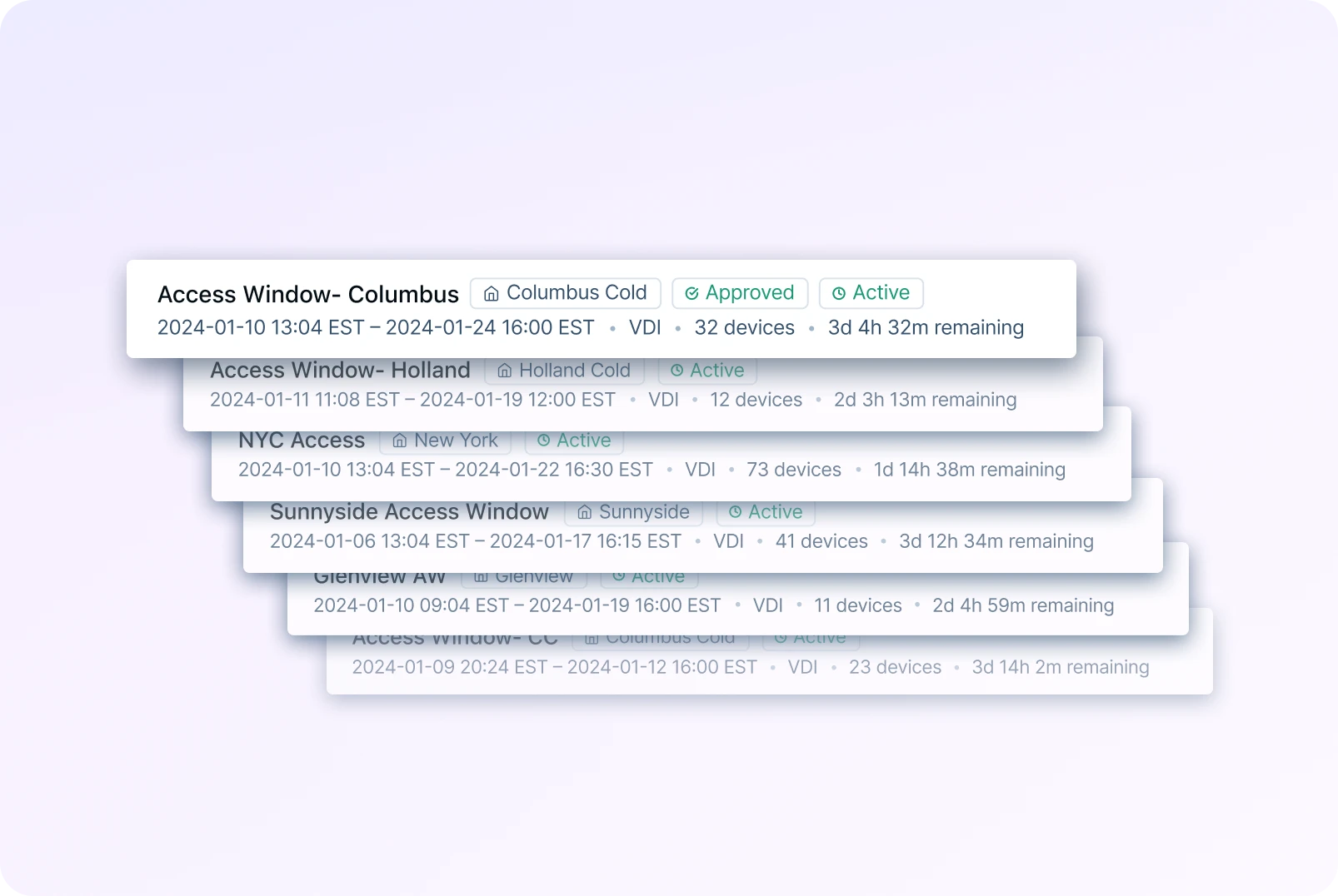
Group Access Windows
## 29 January 2024
{% hint style="info" %}
Published on dispel.com.
{% endhint %}
## Group Access Windows
### Group Access Windows
Access Windows are fast and safe way to allow users "just in time" access to your devices.
With the introduction of Group Access Windows, you can now create Access Windows in bulk and extend them to entire role based access control (RBAC) Groups.
### Facility Level Groups
Groups, and the ability to use invite links to onboard users into them, are a powerful feature for management at scale. Previously, as Groups have the ability to span multiple facilities, these features were only available for organization-wide admins. With this release, we are launching the ability to scope groups and their invite links within a facility level, thus providing enhanced control and flexibility for admins who manage facilities, but not the whole organization. Facility-level admin who have control over even just a single site can now independently create groups, and generate invitation links attached to those groups to efficiently and securely onboard and manage their internal and vendor teams.
### Fixes and Improvements
* Updated our emails to include more local languages
* Fixed a documentation link in the Nozomi Import feature
* Cleared out old API routes to keep everything nice and neat
* Added missing translations for the request access flow
---
# Agent Instructions
This documentation is published with GitBook. GitBook is the documentation platform designed so that both humans and AI agents can read, navigate, and reason over technical content effectively. Learn more at gitbook.com.
## Querying This Documentation
If you need additional information that is not directly available in this page, you can query the documentation by asking a question.
Perform an HTTP GET request on the following URL with the `ask` and `goal` query parameters:
```
GET https://docs.dispel.com/changelog/earlier-releases/2024-01-29.md?ask=&goal=
```
`ask` is the immediate question: it should be specific, self-contained, and written in natural language.
`goal` is what the user is ultimately trying to achieve, the reason they need the answer. Sharing it helps GitBook give you a better, more relevant answer. A goal is most helpful when it describes the outcome the user wants rather than restating the question. For example, with `ask=how do I create an API token`, a goal like `automate deployments from our CI pipeline` lets GitBook tailor the answer to that use case.
The response will contain a direct answer to the question and relevant excerpts and sources from the documentation.
Use this mechanism when the answer is not explicitly present in the current page, you need clarification or additional context, or you want to retrieve related documentation sections.